
John Spencer, the chair of Urban Warfare Studies at US-based think-tank Modern War Institute, said India showcased its ability to strike any target in Pakistan "at will" and drew and enforced a "new red line" for cross-border terrorism under the operation that was launched early on May 7.
A former Pentagon official, Michael Rubin has said that India targeted terror infrastructure with precision, and it was able to blunt Pakistan's response following the recent strikes.

New Tehrik-e-Taliban chief Hakimullah Mehsud surfaced on Monday and vowed to strike United States and Pakistani interests -- to avenge the killing of his slain leader Baitullah Mehsud and American drone attacks on the tribal areas bordering Afghanistan. His appearance in front of a select group of reporters in the South Waziristan tribal area ended speculation over his reported death in a contest for leadership of the Pakistan Taliban, sparked by Baitullah's killing.

The Chinese see no need to fight directly. They have an able and willing proxy in Pakistan, points out Shekhar Gupta.

The post further read that "at a moment of heightened regional turbulence", President Trump "demonstrated great strategic foresight and stellar statesmanship through robust diplomatic engagement with both Islamabad and New Delhi," Dawn reported.
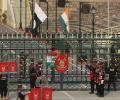
In the India-Pakistan situations, off-ramps have come either through foreign mediation (after months of kinetic warfare over Kargil, and a long stand-off with Op Parakram) or when a situation made it possible for both sides to claim a win, explains Shekhar Gupta.

With this decision, the government headed by Prime Minister Narendra Modi has sought to draw a red line against terror incidents and makes clear that it will follow a similar military response as it has after the Pahalgam incident if terrorists linked to Pakistan target India again.
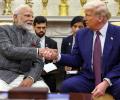
Trump went on to say that "I'm using trade to settle scores and to make peace."
The December 26 drone strike on Pakistan's border with Afghanistan has complicated United States attempts to ease the crisis in relations with Islamabad and stabilise the region before foreign combat troops leave Afghanistan.

The Director General of Air Operations said "whatever methods and whatever means we have chosen, it had the desired effects on the enemy targets",

Trump has repeatedly claimed that he "helped settle" the tensions between India and Pakistan and that he told the nuclear-armed South Asian neighbours that America would do a "lot of trade" with them if they stopped the conflict.
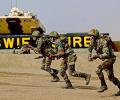
The Indian Army's broader reorganisation is inevitable as India's military doctrine adapts to the demands of the modern battlefield.

There was no reference to trade in talks between top leaders of India and the United States during the India-Pakistan military conflict, government sources said on Monday after American President Donald Trump claimed that he pressured New Delhi and Islamabad to stop hostilities by threatening to cut trade with both countries.

Over 100 terrorists, including high-value targets such as Yusuf Azhar, Abdul Malik Rauf and Mudasir Ahmed, were eliminated during Operation Sindoor on May 7, the Indian military said on Sunday.
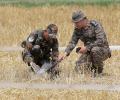
Metal debris was found scattered in three villages of Amritsar district, with some locals claiming them to be parts of missiles. Police are investigating the objects, while the Indian government claims to have foiled Pakistan military's attempts to attack 15 places in northern and western India using missiles and drones. Tensions between India and Pakistan have escalated after India launched missile strikes on terror targets in Pakistan and Pakistan-occupied Kashmir (PoK) in response to the April 22 killing of 26 people by terrorists in Kashmir's Pahalgam.

The Congress party also called for a special session of Parliament to evaluate the situation in detail, to identify any mistakes that were made, and to ensure that they are not repeated in the future.
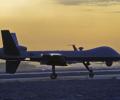
An program by the National Security Agency, which uses metadata and learning algorithms to select targets for drone strikes, may be targetting thousands of innocent people, a report has said.
The Al Qaeda's second in command, Abu Yahya al-Libi, was the main target of the United States drone strike that killed 15 militants in Pakistan's lawless Northwest on Monday and US officials said they were "optimistic" the Libyan had not survived
The Army further made it clear that the continuation of a break in hostilities, as decided in the DGMOs interaction of May 12, has no expiry date to it.

Punjab Kings skipper Shreyas Iyer has delivered a firm and timely reminder of the league's identity

Turkiye and Azerbaijan backed Pakistan and condemned India's recent strikes on terror camps in that country and Pakistan-occupied Kashmir under Operation Sindoor.

Hours after, however, firing from the Pakistani side was reported in Akhnoor sector in Jammu and Kashmir. Drones were also seen in the Pir Panjal area.
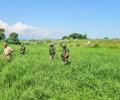
'Why have we failed to address the issue of ensuring a requisite buffer zone in J&K, given that cross-border links of some J&K politicians are known?', asks Lieutenant General Prakash Katoch (retd).

Trump said that leaders in India and Pakistan are "great leaders" and "they understood, and they agreed, and that all stopped".

'Operation Sindoor is still ongoing. The Prime Minister himself said that blood and water cannot flow together, that talks and terrorism cannot go together. So how can we have a cricket match with a country that indulges in terrorism?'

India's Foreign Secretary Vikram Misri said on Thursday that the choice of de-escalation is with Pakistan, as India only responded to the April 22 Pahalgam terror attack, which killed 26 people. He added that Pakistan has been escalating the situation with cross-border terrorism against India for decades.

Several top Indian athletes and former cricketers have rallied behind the Indian Armed Forces, expressing solidarity, pride, and gratitude for their bravery during Operation Sindoor.

Army Chief General Upendra Dwivedi asserted that Operation Sindoor was unlike any conventional mission and that it was akin to playing a game of chess as 'we did not know' what would be the enemy's next move.

Authorities in Jammu and Kashmir on Sunday asked border villages residents, who were evacuated to safer places in view of cross border shelling by Pakistan, not to rush back to homes as they are yet to sanitise and clear these areas of any unexplored shells.

The domestic stock market this week would monitor the geopolitical developments after India and Pakistan reached an understanding to stop military actions, analysts said. Moreover, macroeconomic data announcements, Q4 earnings, trading activity of foreign investors and global market trends are also likely to influence sentiments, traders said.
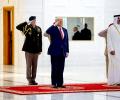
'He is intrigued by the intractability of Kashmir issue. With his interest in dealmaking and peacebrokering, he sees it as an exciting challenge to tackle.'
The nine targets struck under 'Operation Sindoor', four in Pakistan and five in Pakistan-occupied-Kashmir, were chosen by the IAF after receiving intelligence inputs about terror camps operating under the guise of health centres to evade detection at these sites, officials said on Wednesday.
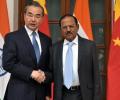
Wang also condemned the April 22 terror attack in Jammu and Kashmir's Pahalgam, which had cross-border linkages and triggered the worst fighting between India and Pakistan in years.

The Border Security Force (BSF) remains on high alert along the International Border (IB) and has not let its guard down, BSF Inspector General, Jammu Frontier, Shashank Anand said on Tuesday. Operation Sindoor, aimed at preventing infiltration attempts, continues as Pakistan cannot be trusted, he added. Anand highlighted the BSF's robust response after the April 22 Pahalgam terror attack, including destroying multiple terror launch pads and thwarting infiltration attempts.

Pakistan on Thursday said that the country's air force struck terrorist hideouts in Iran's Siestan-Balochistan province, a day after Islamabad recalled its ambassador from Tehran in the wake of Iranian missile and drone strikes in Balochistan.

The International Monetary Fund (IMF) has slapped 11 new conditions on Pakistan for the release of the next tranche of its bailout programme and warned that tensions with India could heighten risks to the scheme's fiscal, external, and reform goals, according to a media report on Sunday.

The highlight of Tuesday's debate on Operation Sindoor was the speech by Prime Minister Narendra Modi, with the rebuttal by Congress's Wayanad MP Priyanka Gandhi coming a close second.
'The Pakistanis called the US state department and said we agree with India on peace.' 'It was then that US President Donald Trump jumped in and took credit for the ceasefire.'

The four new Heron Mark-2 drones, which can be equipped with long-range missiles and other weapons systems, have been deployed at a forward air base in the northern sector, where Team ANI witnessed their operations.

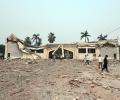
People along the Line of Control and International Border in the Jammu region continue to live under the shadow of death, with unexploded mortar shells fired by Pakistani troops still embedded in farmlands and residential areas even though hostilities have stopped for nearly a week. IMAGE: Kindly note that this image has been posted for representational purposes only. Photograph: / Rediff.com Despite the May 10 understanding between India and Pakistan, locals describe the border areas as a 'death trap'. Sixty-two-year-old Balvinder Singh, who returned to his home in Pargwal sector on May 14, recounted a narrow escape. "Two shells exploded in our compound, damaging our house. Three more landed on our farmland. We were terrified and told our family to stay away from the fields until the Army could help," Singh told PTI. Army engineers later came to the village and safely defused the unexploded shells, bringing a temporary sense of relief. "Fear is writ large on the faces of people to these death traps in border hamlets", he said. Scenes of destruction are evident rooftops torn apart, broken houses, windows punctured by shrapnel, and carcasses of cattle lying in pools of blood. The acrid smell of gunpowder still lingers in the air. Sardar Gurmeet Singh faced a similar ordeal. His family could not re-enter their home as a live mortar shell had sunk into the compound in a village close to the International Border. "The army's bomb disposal squad removed it after four days, allowing us to finally enter, back home," he said. Indian Army engineers have launched a sweeping clearance operation across border districts, defusing over 80 unexploded shells in the past five days -- including 6 in Pargwal, 19 in Rajouri, 42 in Poonch, and 12 along the IB. "These shells, mostly 120 mm calibre, have a range of 15 to 30 km and pose a serious threat to both civilian and military targets," an Army officer said. "Many of them were fired by Pakistan during recent hostilities." On May 7, the Indian Army launched Operation Sindoor, conducting precision strikes on nine terror hubs in Pakistan and Pakistan-occupied Jammu and Kashmir (PoJK) in response to the April 22 terror attack in Pahalgam that killed 26 people, most of them tourists. The subsequent retaliation by Pakistan pushed the region to the brink of war. From 7 to 10 of May, 27 civilians were killed and over 70 injured in Pakistani shelling in the Jammu region. Farid Din Gujjar, a resident near the border, expressed fear about returning to his fields. "Several shells created deep craters in our paddy land. We cannot resume work until all unexploded ordnance is cleared. It's a death trap," he said. Army units, in coordination with Jammu and Kashmir Police, have evacuated high-risk zones and issued stern warnings to residents not to touch any suspicious objects or unexploded shells. In one major operation, 42 live shells were safely destroyed in the Poonch villages of Jhullas, Salotri, Dharati and Salani. "All safety protocols were followed. The shells posed a serious danger to local lives," an Army spokesperson said, calling the effort a 'continued commitment to protect civilians and restore normalcy'. Poonch saw the vast majority of deaths due to shelling. Security officials said that Pakistan used a mix of mortar shells, armed drones, and missiles during the shelling spree, specifically targeting civilian habitations and border towns in Jammu, Samba, Kathua, Rajouri, and Poonch. As clearance operations continue, the border residents are slowly returning to their homes, but with caution, fear, and lingering uncertainty about shelling that may yet happen in the future.
